
Shocking Report: 2 Out of 3 South Sudanese Children Trapped in Child Labour!
10/29/20252 min read
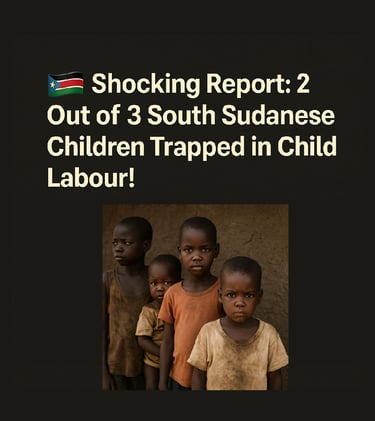
JUBA: Nearly two-thirds of South Sudan’s children are involved in some form of child labour, with rates soaring to as high as 90 percent in certain regions ravaged by conflict, poverty, and climate disasters, a new government-backed study has revealed.
The National Child Labour Study, published in partnership with Save the Children, surveyed more than 418 households across seven states. The findings paint a grim picture — around 64 percent of children aged 5 to 17 are engaged in exploitative or hazardous work, including forced labour, sexual abuse, theft, and participation in armed conflicts.
Crisis Deepens Amid Conflict and Flooding
Researchers described the situation as a humanitarian emergency worsened by years of instability, floods, disease outbreaks, and widespread hunger. The crisis, they said, extends far beyond poverty.
In Kapoeta South, near the Ugandan border, nearly nine out of every ten children are employed in gold mining, livestock herding, or agriculture, depriving them of education. Similarly, in the Yambio region, violence and early marriages have forced countless children into labour.
The report also found that 10 percent of surveyed children admitted to working with armed groups, particularly in Akobo, Bentiu, and Kapoeta South counties.
Gender-Based Exploitation on the Rise
The types of exploitation differ between boys and girls. Boys are more often recruited into dangerous manual labour or armed conflict, while girls face higher risks of domestic servitude, sexual abuse, and forced marriage.
‘A Crisis That Goes Beyond Poverty’
Despite awareness campaigns, legal knowledge has not curbed the crisis. About 70 percent of children in illegal or hazardous work come from households that understand child protection laws, while two-thirds of children remain unaware that support services even exist.
“When nearly two-thirds of a nation’s children are working — and in some areas, almost every child — it reflects a crisis that goes beyond poverty,” said Chris Nyamandi, Save the Children’s Country Director for South Sudan.
“Education remains the most powerful shield against exploitation,” he added, emphasizing the urgent need to get children back into classrooms.
Child Labour Rate Double the Regional Average
According to data from ILO-UNICEF, East Africa already has the highest child labour rate in Africa at around 30 percent. South Sudan’s 64 percent rate is more than double that figure, underscoring the severity of the crisis.
Government Vows Action Amid Escalating Challenges
Speaking at the report’s launch in Juba, Deng Tong, Undersecretary at the Ministry of Labour, acknowledged the scale of the problem and pledged to use the findings as a “foundation for decisive action.”
The crisis coincides with severe flooding that has affected nearly one million people, displacing 335,000 and damaging more than 140 health facilities. The country also battles a malaria outbreak with over 104,000 cases reported in a single week, while 7.7 million people face acute hunger, according to the United Nations.
Political Instability Worsens Humanitarian Outlook
South Sudan’s fragile peace remains under threat. A 2018 peace agreement between President Salva Kiir and First Vice President Riek Machar is faltering, with renewed fighting reminiscent of the pre-2017 civil war era.
Machar, who was arrested in March and later charged with treason, murder, and crimes against humanity, has rejected all allegations. Escalating violence has already forced over 300,000 people to flee the country this year alone.