Iran, Pakistan & Turkey Join Tracks Again! Historic Islamabad–Tehran–Istanbul train to roll out this December
10/28/20252 min read
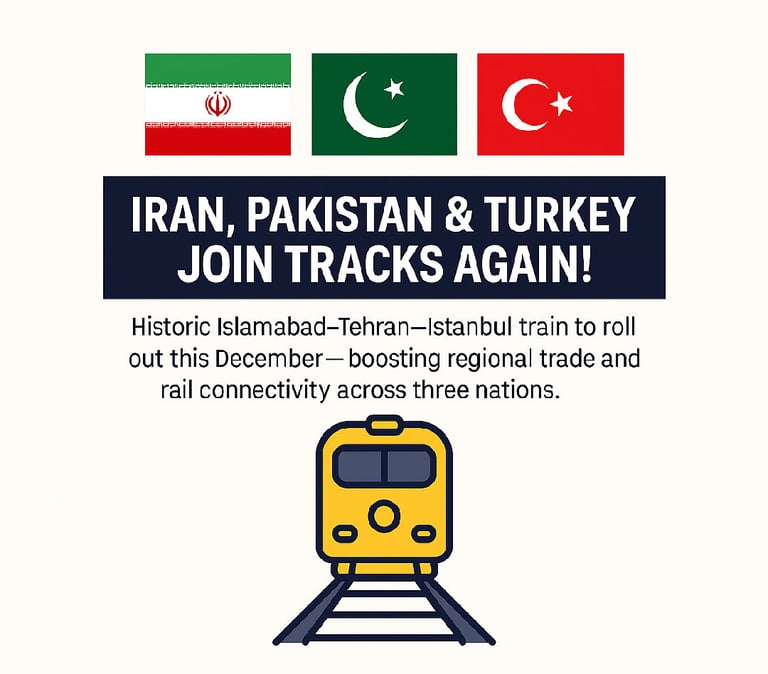
TEHRAN – In a major boost for regional trade and transport connectivity, Iran and Pakistan have agreed to restart the Islamabad–Tehran–Istanbul (ITI) container train service this December, re-establishing a vital rail corridor linking South Asia with the Middle East and Europe.
The decision came after a series of high-level meetings between Iran’s Minister of Transport and Urban Development Farzaneh Sadegh and Pakistan’s Ministers of Commerce, Communications, and Railways — Jam Kamal Khan, Abdul Aleem Khan, and Hanif Abbasi — during Sadegh’s official visit to Islamabad.
According to Pakistan’s Ministry of Railways, both sides will soon finalize a joint action plan to enhance rail cooperation. They also agreed to begin upgrading the Quetta–Taftan railway line next year, a key section that connects the two countries’ rail networks.
Expanding Trade Through Rail Connectivity
Both nations reaffirmed their commitment to strengthening commercial and passenger train operations, establishing a coordinated follow-up mechanism to ensure timely implementation of agreements.
Minister Sadegh emphasized that the ITI corridor could serve as a strategic trade link — connecting China’s Belt and Road routes to European markets through Iran and Pakistan. She highlighted the importance of executing past accords reached during the 22nd Iran–Pakistan Joint Economic Commission in Tehran to deepen long-term cooperation.
The recent Regional Transport Conference in Islamabad — attended by representatives from 11 countries — concluded with optimism about transforming the region into a thriving hub for transit trade and logistics.
New Barter Trade Order to Boost Bilateral Commerce
In a related development, Pakistan has issued a new executive order to facilitate barter trade with Iran, following months of consultation between both sides.
Pakistan’s Ambassador to Tehran, Muhammad Mudassir Tipu, announced the move on social media, stating that the new order addresses concerns raised by business communities in both countries. He encouraged industrialists and chambers of commerce to make full use of the updated regulation, which aims to diversify trade and remove procedural bottlenecks.
Earlier, Pakistan’s Ministry of Finance had approved the revised barter trade framework prepared by the Ministry of Commerce, later endorsed by the federal cabinet under Prime Minister Shehbaz Sharif.
Private Sector Takes Center Stage
The 22nd Joint Economic Committee meeting marked a turning point, with active participation from the private sector. Over 150 companies from both sides — including 50 from Iran and more than 100 from Pakistan — attended a joint business forum in Tehran, showcasing opportunities for direct trade, joint ventures, and cross-border investment.
Iranian firms represented sectors such as energy, petrochemicals, food processing, pharmaceuticals, and construction, while Pakistani participants came from agriculture, textiles, transportation, and IT industries. The engagement underscored the untapped potential for technology exchange and industrial collaboration between the two neighbors.
Strategic Corridor Linking Asia to Europe
Both Iran and Pakistan occupy pivotal positions in regional transport corridors — Iran acting as a bridge between Central Asia, the Caucasus, and the Persian Gulf, and Pakistan serving as a gateway to South Asia and the Indian Ocean.
Upgrading joint rail and road infrastructure, developing modern border terminals, and leveraging Gwadar and Chabahar ports as transit hubs could significantly lower transport costs and expand trade volume.
Despite existing challenges such as international sanctions on Iran, border security issues, and financial transaction limitations, both governments expressed strong determination to overcome obstacles and unlock the full potential of regional integration.