
😓 Pakistan’s Working Class Paying the Price!
10/24/20252 min read
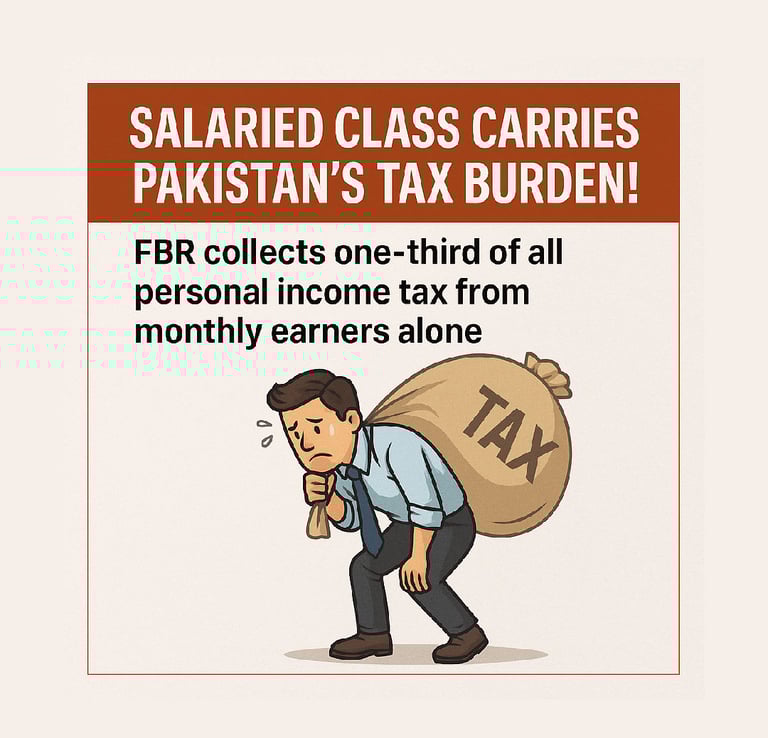
Islamabad, October 21, 2025: Despite a downward revision in salary slabs under the Finance Act 2025, Pakistan’s salaried class continues to bear a heavy financial load, contributing nearly one-third of all personal income tax collected by the Federal Board of Revenue (FBR).
According to official data, the FBR amassed Rs138 billion from salaried individuals during the first quarter of FY2025-26, a sharp rise from Rs110 billion collected during the same period last year — reflecting an increase of nearly Rs20 billion.
Salaried Taxpayers Contribute 29% of Total Personal Tax
The FBR’s latest figures show that salaried taxpayers accounted for 29% of Pakistan’s total personal income tax (PIT), amounting to Rs1,936 billion. This marks a dramatic increase from just 10% in FY2018-19, as the share of the salaried class has grown consistently year after year.
The contribution trend highlights a worrying imbalance:
2018–19: 10%
2019–20: 12%
2020–21: 12%
2021–22: 19%
2022–23: 25%
2024–25: 29%
During the same period, the FBR’s total revenue nearly tripled, rising from Rs3.8 trillion in 2018-19 to Rs11.7 trillion in 2024-25. Yet, the salaried class’s share of total revenue remains modest — just 5%, reflecting that while individual taxpayers are paying more, the overall tax net remains narrow.
Personal Income Tax Share Declines Despite Higher Collections
FBR data further indicates that personal income tax (both salaried and non-salaried) now constitutes 16% of the total revenue, down from 19% in FY2018-19. Analysts say this points to an uneven tax system that continues to rely on compliant salary earners rather than expanding the tax base.
Experts Call It ‘Unfair Targeting’
A senior tax policy expert criticized the government’s claims of growth in revenue collection, saying the apparent increase from 8.83% to 10.33% of GDP came not from better enforcement but from “overburdening the same taxpayers.”
He pointed out that in Tax Year 2022, salaried employees paid Rs189 billion, which surged to Rs560 billion last year — and is expected to touch Rs700 billion this year.
“This isn’t a story of success — it’s a story of unfair targeting,” he said.
Drastic Changes to Upper Tax Slab
Experts have also questioned the sharp reduction in the upper income slab, taxed at 35%, which was cut from Rs75 million to just Rs4.1 million annually — a move described as “unprecedented globally”.
“By taxing incomes above Rs4.1 million (around USD 14,500) at 35%, we are penalizing our most skilled professionals,” said the tax analyst.
“Our brightest minds are leaving Pakistan because of this unsustainable taxation. Nearly half of their income is lost to direct and indirect taxes, crushing their purchasing power.”
He warned that the current tax structure is “not reform but economic self-destruction,” adding that the rise in FBR’s revenue reflects the silent sacrifice of the salaried class, not improved governance.
Silent Sacrifice Behind Pakistan’s Tax Growth
As FBR celebrates rising tax receipts, experts stress that Pakistan’s economic stability increasingly depends on a shrinking pool of compliant professionals — the salaried class — who continue to shoulder an unfair and unsustainable burden while millions remain outside the tax net.