
🔥 No Heat, No Pressure — Still a Diamond! Scientists unveil a revolutionary way to grow real diamonds in lab conditions.
11/2/20252 min read
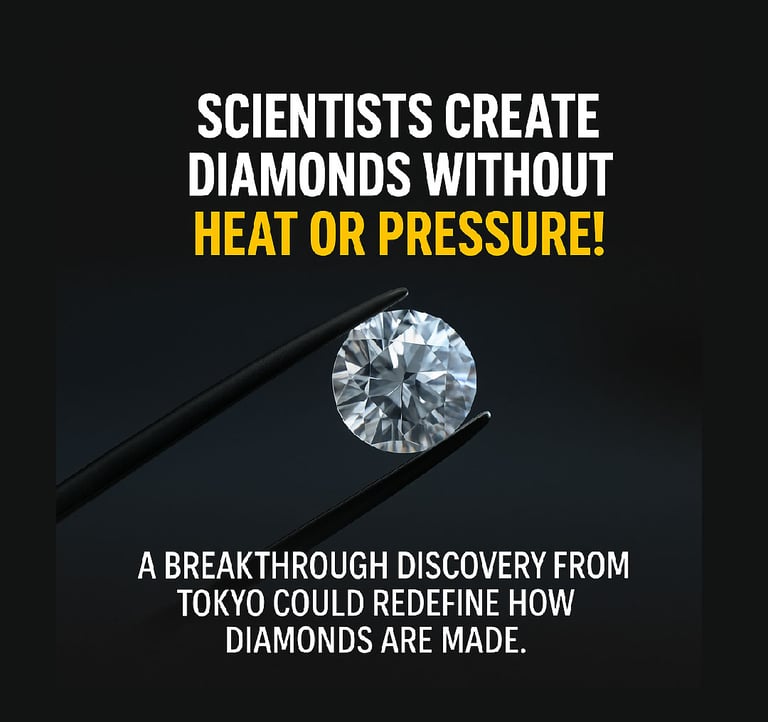
Scientists Create Diamonds Without Extreme Heat or Pressure — Tokyo Team’s Breakthrough Stuns Researchers
A revolutionary discovery by scientists at the University of Tokyo has revealed a new method to create synthetic diamonds — no intense heat or crushing pressure required. This breakthrough could transform not only diamond manufacturing but also future applications in materials science, biotechnology, and quantum computing.
A Cold Route to Diamond Creation
Traditionally, producing diamonds involves exposing carbon to immense heat and pressure, or using chemical vapor deposition (CVD) — a method that relies on gas-phase reactions. However, the Japanese research team led by Professor Eiichi Nakamura has developed a remarkably different approach that challenges conventional understanding.
Instead of extreme physical conditions, the scientists used controlled electron irradiation on a carbon-based molecule known as adamantane (C10H16). By carefully targeting the substance with an electron beam, they successfully transformed it into diamond-like structures — all without damaging its fragile molecular framework.
Electron Beams Replace Fire and Pressure
Using transmission electron microscopy (TEM) — a powerful imaging tool capable of visualizing atoms — the researchers exposed tiny adamantane crystals to electron beams between 80 and 200 kiloelectron volts, under precise temperatures ranging from 100 to 296 kelvins in a vacuum environment.
To their surprise, the electron exposure not only triggered the formation of nanodiamonds but also preserved the integrity of surrounding carbon compounds. This means electrons can drive well-defined chemical reactions instead of destroying delicate organic molecules — a major step forward in safe material transformation.
How Diamonds Formed in Seconds
The study showed that as the C–H (carbon–hydrogen) bonds in adamantane broke, C–C (carbon–carbon) links formed, reorganizing the atoms into a three-dimensional diamond lattice. Over time, the molecules gradually fused into spherical nanodiamonds with diameters of up to 10 nanometers, characterized by a perfect cubic structure.
Interestingly, when researchers tried other hydrocarbons, none produced the same diamond-forming effect — highlighting adamantane’s unique stability and suitability for controlled diamond synthesis.
Implications Beyond the Lab
This innovative process not only hints at how natural diamonds might form inside meteorites but also opens new possibilities for creating quantum dots — microscopic particles essential to quantum computing and next-generation electronics.
By demonstrating that electrons can act as precise chemical tools, the University of Tokyo team has introduced a safer, more efficient path for growing diamonds, with potential uses in nanotechnology, medicine, and industrial design.
A Step Toward the Future of Diamond Science
The discovery marks a paradigm shift in the world of material synthesis. It proves that extreme heat and pressure are no longer prerequisites for diamond creation — paving the way for cleaner, faster, and more sustainable diamond production.
As Professor Nakamura’s team continues its research, this method could soon redefine how we understand not only diamonds but the very limits of chemical transformation at the molecular level.