
💉 “No Child Left Behind” — WHO Vows to End Polio. Global health drive continues in Pakistan despite 30% funding slash
10/23/20252 min read
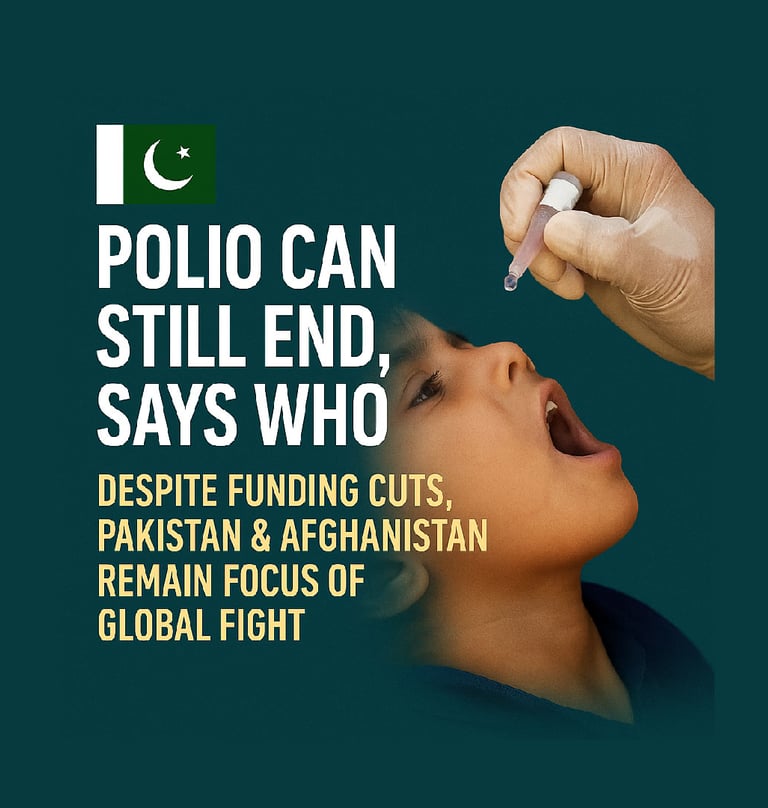
WHO Says Polio Eradication Still Achievable Despite Major Funding Cuts
LONDON:
Global health authorities have reaffirmed that the fight to eliminate polio worldwide remains achievable, even as the initiative faces severe financial constraints and reduced international aid.
The Global Polio Eradication Initiative (GPEI) — a partnership that includes the World Health Organization (WHO), the Bill & Melinda Gates Foundation, and other key global health players — announced a 30% budget reduction starting in 2026, resulting in a $1.7 billion funding gap through 2029.
According to WHO officials, the financial shortfall has primarily stemmed from declining foreign assistance, particularly following the United States’ withdrawal from the WHO and decreased contributions from other major donors such as Germany and the United Kingdom.
Despite these setbacks, WHO Director for Polio Eradication Jamal Ahmed emphasized that the organization will continue essential operations in high-risk countries like Pakistan and Afghanistan, where the virus remains endemic.
“Eradication remains feasible and achievable,” Ahmed said. “We must stay united to ensure no child is left behind.”
Focus Shifts to High-Risk Areas and Smarter Strategies
To manage limited resources effectively, the GPEI plans to intensify surveillance and vaccination drives in regions with ongoing transmission risks while scaling back activities in lower-risk zones.
The initiative also aims to integrate its work with other global health programs, such as measles vaccination campaigns, and employ cost-efficient methods like fractional dosing — using one-fifth of a vaccine dose per child, which research shows remains effective in providing immunity.
However, Ahmed acknowledged that the funding cuts would inevitably slow progress:
“The reductions in financial support mean that some activities will simply not take place,” he warned.
Polio Eradication: A Global Health Mission Near the Finish Line
The global campaign to wipe out polio began in 1988, leading to a dramatic decline in cases worldwide. Yet, challenges such as conflict zones, vaccine misinformation, and inconsistent funding continue to hinder complete eradication.
As of 2025, there have been 36 confirmed cases of wild poliovirus in Pakistan and Afghanistan, while 149 cases of vaccine-derived poliovirus were detected in several countries, including Nigeria, according to GPEI data.
Public health advocates insist that halting efforts now would undo decades of hard-won progress. Experts continue to call for sustained commitment from governments and donors to finally end the paralysis-causing virus once and for all.