
🌊 Letters From the Past Resurface! WWI soldiers’ bottle discovered after a century — a miracle of history and heart. ❤️
10/30/20252 min read
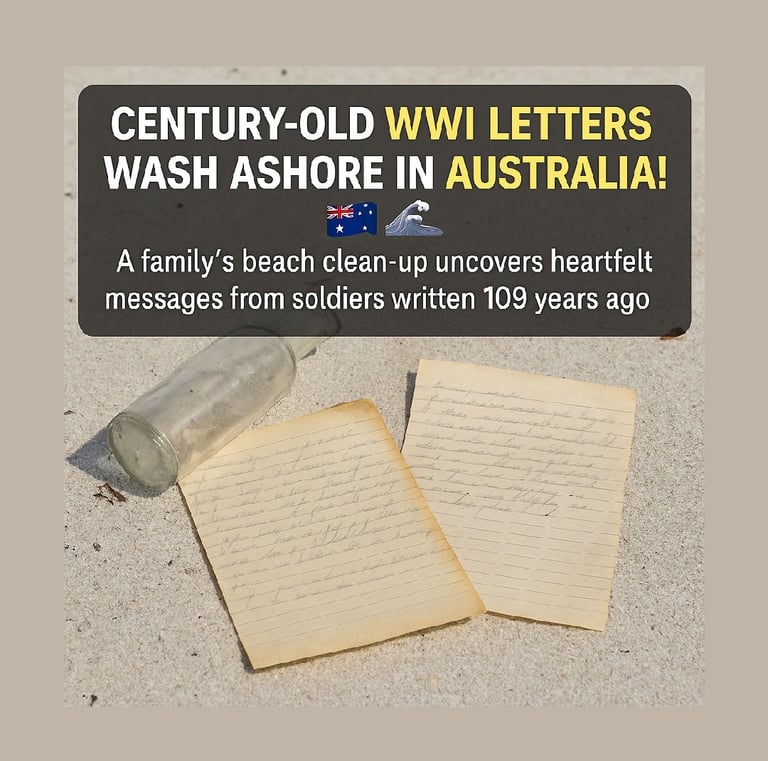
Century-Old WWI Letters Found in Bottle on Australian Beach Reunite Families After 109 Years
Esperance, Australia:
What started as a family’s routine beach clean-up in Western Australia turned into a remarkable discovery linking the present to the past. During a weekend outing near Wharton Beach, the Brown family stumbled upon a glass bottle containing two letters written by Australian soldiers during World War I — messages that had remained hidden beneath the sand for over a century.
Letters From the Great War Resurface
The unexpected find occurred when Deb Brown and her family spotted an old Schweppes glass bottle resting near the shoreline. Inside were two handwritten notes dated August 15, 1916, penned by soldiers Private Malcolm Neville and Private William Harley aboard the troopship HMAT A70 Ballarat.
Both men were en route from Adelaide to the European front as part of the 48th Australian Infantry Battalion. Their letters, written in pencil, reflected striking optimism and humor despite the grim realities that awaited them.
Neville’s message, addressed to his mother in South Australia, spoke cheerfully about life aboard the ship:
“Having a real good time — food is good, except one meal we buried at sea. The ship is rolling but we are as happy as Larry.”
Harley’s note, meanwhile, was meant for an unknown finder. Since his mother had passed away before the voyage, he left a simple yet heartfelt message:
“May the finder be as well as we are at present. Somewhere in the Bight.”
Preserved by Time and Nature
Experts believe the bottle likely washed ashore soon after being thrown overboard, then remained buried in sand dunes for more than 100 years. The bottle’s pristine condition and legible handwriting indicate minimal exposure to water or sunlight — a rare case of natural preservation.
According to Deb Brown, the find was completely unexpected:
“We never leave rubbish behind, so when we saw the bottle, we picked it up — never imagining it held history inside.”
A Search for Descendants
Moved by the discovery, Deb Brown began tracing the soldiers’ families. Through online research, she located Malcolm Neville’s great-nephew, Herbie Neville, and William Harley’s granddaughter, Ann Turner.
When contacted, both families were deeply emotional. Turner described the discovery as “a miracle — it feels like our grandfather reached out to us from the past.”
Neville’s descendants expressed both pride and sorrow upon learning that Malcolm had died in France less than a year after writing the letter.
A Window Into the Past
Historians describe the letters as a rare, unfiltered glimpse into the minds of young men heading to war, capturing their courage, humor, and humanity. Harley survived the war but suffered lifelong health issues from gas exposure in the trenches, passing away in 1934.
Environmental Effort Turns Into Historical Discovery
The Brown family, known locally for their beach clean-ups, see the discovery as a reward for years of environmental work.
“It’s incredible — we went to clean the beach and ended up uncovering history,” Deb said.
They plan to return the letters to the families while keeping the bottle as a keepsake — a reminder of how a simple act of care for nature can bridge a century of human history.
A Message Beyond Time
The rediscovery of the Wharton Beach bottle stands as a moving testament to the endurance of memory and connection. It reminds us that the past is never truly gone — only waiting to be found.