
🔋 Less Load, More Sun! Pakistan’s power demand drops 5% as solar trend rises nationwide.
10/31/20252 min read
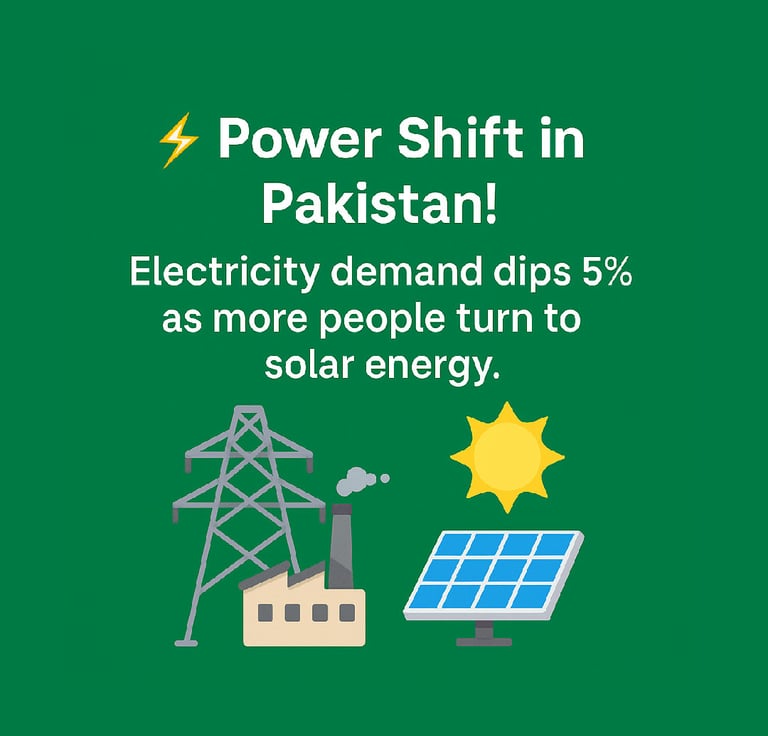
ISLAMABAD: Pakistan’s electricity demand saw a significant decline of 5.33 percent in September 2025, largely due to the country’s accelerating shift to solar energy and sluggish industrial activity, according to data presented during a National Electric Power Regulatory Authority (NEPRA) hearing.
The Central Power Purchasing Agency (CPPA-G) reported that actual electricity generation in September stood at 12.59 billion kilowatt-hours (BkWh) — down from the reference projection of 13.30 BkWh for the month. The reduced demand reflects changing consumption patterns and a growing preference among households and businesses for self-generated solar power.
CPPA-G Seeks Refund Approval from NEPRA
In its petition filed on behalf of ex-WAPDA distribution companies and K-Electric, the CPPA-G stated that the reference fuel cost for September was Rs7.6554 per unit, while the actual generation cost averaged Rs7.2873 per unit.
As a result, the agency has requested NEPRA’s approval to refund Re0.37 per unit (approximately Rs4.5 billion in total) to consumers through the Fuel Cost Adjustment (FCA) mechanism for the month of September.
The hearing, chaired by NEPRA Member (Legal) Amina Malik, highlighted that both residential and industrial power consumption fell by a similar margin. Officials attributed the decrease to economic slowdown and an increasing reliance on solar systems across the country.
Solarization Impact: Daytime Drop, Nighttime Surge
Officials from the National Power Control Centre (NPCC) revealed that widespread solar adoption has created a new operational challenge for Pakistan’s power grid.
During daylight hours, electricity demand drops by nearly 6,000 megawatts, sometimes bringing total load down to around 15,000 MW. However, after sunset, demand surges beyond 21,000 MW, causing a strain on the system.
“Power plants cannot be turned on or off instantly to match these fluctuations,” NPCC officials warned, noting that this uneven demand pattern can cause inefficiencies and increased costs for power producers.
Industrial Slowdown and Generation Mix
The hearing also noted that furnace oil-based power generation increased by 6 percent compared to August, indicating continued reliance on expensive energy sources. Officials linked the decline in industrial usage to high electricity tariffs but said the government is considering incentive packages to boost industrial consumption and stabilize demand.
According to the presented data, no electricity was generated from the China Power Hub Generation Company in September, while the CPPA-G also sought permission to recover Rs9.34 billion in prior adjustments.
Consumer Relief Expected Soon
If approved, NEPRA’s decision will benefit both Discos and K-Electric consumers with a refund of Rs0.37 per unit on their upcoming electricity bills. The regulator is expected to issue its final verdict after reviewing the submitted data and financial details.