
😷 Karachi climbs global pollution list — Lahore not far behind! Air quality plunges to ‘unhealthy’ levels amid rising smog
10/21/20252 min read
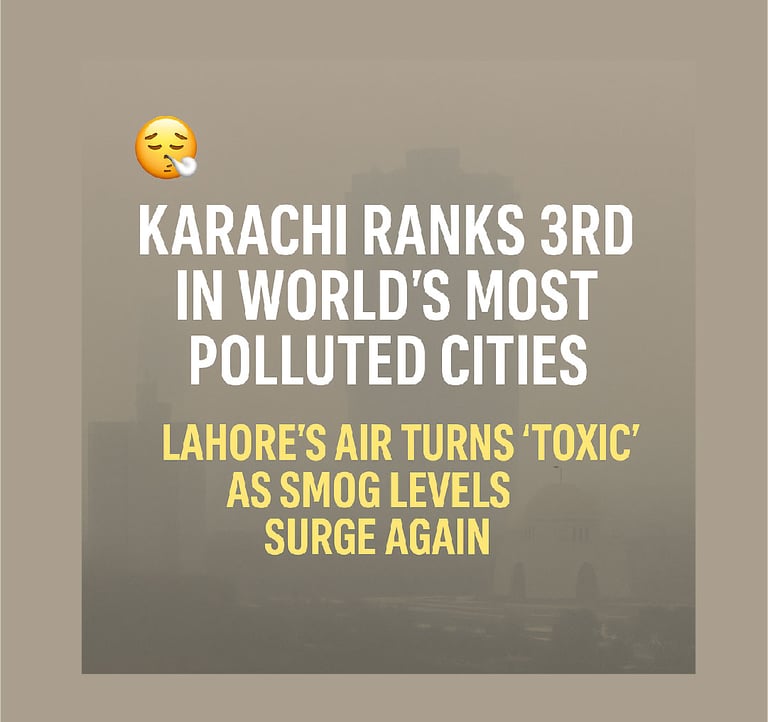
KARACHI / LAHORE: Pakistan’s economic powerhouse, Karachi, has been listed as the third most polluted city in the world, according to the latest Air Quality Index (AQI) released by IQAir, a global Swiss-based air monitoring organization.
Meanwhile, Lahore’s air quality has plunged to alarming levels, recording a pollution index of 268, placing it firmly in the ‘very unhealthy’ category. Experts estimate that the city’s average AQI will fluctuate between 210 and 240 throughout the day, keeping residents under hazardous air conditions.
To combat the worsening situation, the Punjab government has intensified anti-smog measures — including a ban on stubble burning, heavy fines on smoke-emitting vehicles, and the deployment of anti-smog guns in high-risk areas.
“The major contributor to poor air quality right now is the polluted air drifting from Indian Punjab and surrounding regions,” explained Sajid Bashir, spokesperson for the Punjab Environment Protection Agency (EPA).
In Karachi, air quality readings reached 198, classifying the city’s atmosphere as ‘unhealthy’ for the public. Across the border, Mumbai, India’s financial hub, followed closely behind, ranking fourth on the global pollution index.
Environmental experts have also cautioned that smoke and emissions from Delhi may further aggravate smog and fog conditions in Lahore and central Punjab over the coming days.
Delhi Tops Global Pollution Chart After Diwali Fireworks
According to a Reuters report, New Delhi’s air quality deteriorated to hazardous levels on Tuesday, recording the highest pollution readings globally. IQAir data showed Delhi’s AQI at 442, making it the world’s most polluted major city.
The sharp spike in pollution came right after the Diwali festival, when the Indian Supreme Court permitted the use of limited “green crackers” for a few hours during celebrations. However, witnesses reported widespread violations, with fireworks continuing beyond the allowed timeframe.
Although labeled “eco-friendly,” these crackers still release 30% to 50% fewer emissions than traditional fireworks — insufficient to prevent the city’s air from turning toxic.
Delhi’s PM2.5 concentration was measured at 59 times higher than the World Health Organization’s safe limit, posing severe risks of respiratory illnesses, heart disease, and premature death. India’s Central Pollution Control Board (CPCB) rated the capital’s air as “very poor” with an index score of 350, far above the healthy range of 0–50.
Officials predict no immediate improvement, as winter weather traps dust, vehicle exhaust, and crop-burning smoke close to the ground — a seasonal pattern that leaves millions struggling to breathe across northern India and Pakistan.