
🚀 China Sends Youngest Astronaut — and Mice — to Space Station! 🐭✨
11/2/20251 min read
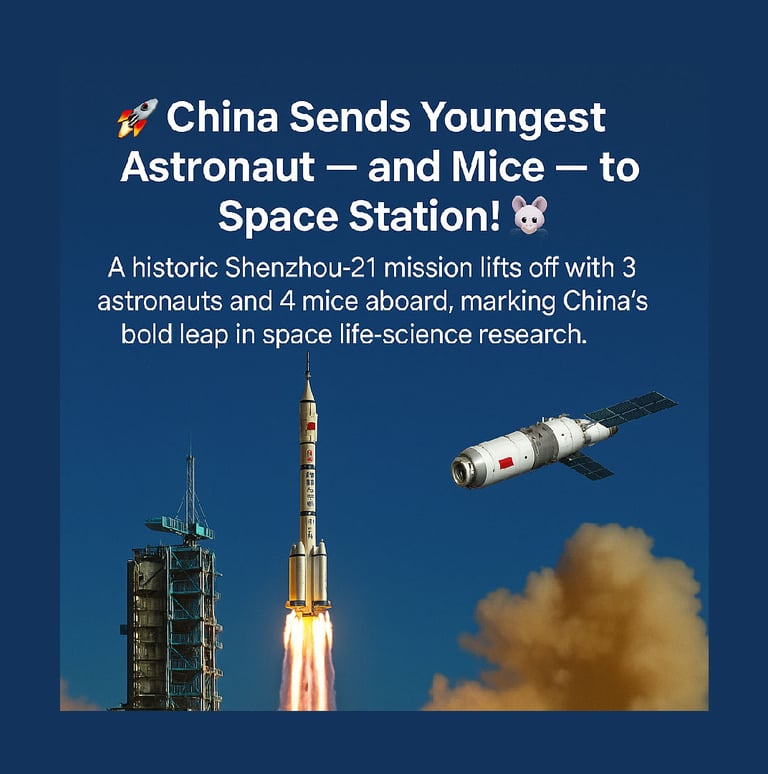
China has successfully embarked on a new chapter of its space exploration journey with the Shenzhou-21 mission, which launched early Friday from the Jiuquan Satellite Launch Center. The spacecraft carries a three-member crew—featuring China’s youngest-ever astronaut—along with four mice that will play a key role in groundbreaking biological research aboard the Tiangong Space Station.
A New Era in Space Research
The six-month mission aims to push the boundaries of scientific discovery, with the crew—known as taikonauts—set to perform 27 advanced experiments in orbit. Their research will focus on space life sciences, biotechnology, and aerospace medicine, generating vital insights for future long-duration space missions. The data collected will help China refine technologies needed for sustainable human presence in space.
Mice Experiments to Study Life in Space
In a historic first, four mice (two male and two female) have been sent to the Tiangong station to help scientists study how microgravity and isolation impact living organisms. These rodent experiments will examine behavioral and biological changes during prolonged space exposure. Upon return, researchers will analyze their organs and tissues to understand how space conditions affect health and adaptation—information that could one day help astronauts survive longer missions to the Moon and Mars.
Expanding China’s Space Ambitions
The Shenzhou-21 mission underscores China’s growing leadership in human spaceflight and orbital research. It marks the country’s sixth crewed mission to Tiangong, further advancing its ambitious plan to develop a permanent, self-sustaining space outpost. The launch follows the successful completion of Shenzhou-20, whose crew spent 188 days in orbit. Commander Chen Dong set new national records for cumulative time spent in space and the number of spacewalks completed.
This latest mission highlights China’s determination to blend innovation, scientific discovery, and international prestige as it accelerates toward becoming a major global space power.