
🌍 China Just Found Earth’s Largest Crater! The 10,000-year-old Jinlin impact site is unlike anything seen before.
10/23/20252 min read
Guangdong, China — October 23, 2025:
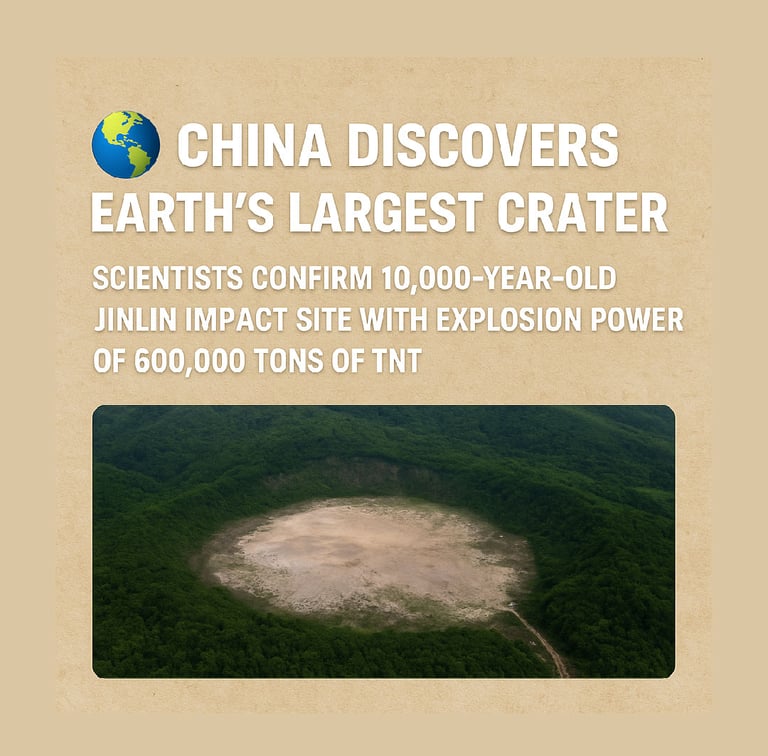
China’s Academy of Engineering Physics (CAEP) has officially confirmed that the Jinlin impact crater in southern China’s Guangdong Province is the largest known crater on Earth formed during the Holocene epoch, which spans the last 11,700 years.
Located in the mountainous terrain of Deqing County, the Jinlin site has been identified as a remarkably young impact formation. Scientists reached this conclusion after analyzing the chemical weathering rate of nearby granite, which revealed that the impact event occurred sometime in the early to middle Holocene period.
Scientific Discovery and Analysis
The breakthrough findings were recently published in the scientific journal Matter and Radiation at Extremes.
Lead author Chen Ming, a researcher at CAEP’s Center for High Pressure Science and Technology Advanced Research, explained that field surveys and geological sampling uncovered clear signs of shock metamorphism — a transformation in rocks and minerals that occurs under extreme pressure from an impact.
This evidence confirmed that the crater was created by a high-speed collision with a small celestial object, rather than by natural geological movements within the Earth’s crust.
A Massive 900-Meter Crater
Previous Holocene craters found around the world have generally been small, rarely exceeding 100 meters in diameter. The largest known before Jinlin was about 300 meters across.
By contrast, the Jinlin crater spans nearly 900 meters, leading geologists to estimate that the impact released energy equivalent to 600,000 tons of TNT — a force capable of reshaping vast landscapes in an instant.
Expanding China’s Geological Record
Until now, scientists had identified only four confirmed impact craters in northern China. The discovery in southern China marks a first, as the region’s intense weathering and biological activity had previously erased surface traces of ancient craters.
Experts say this discovery is not only vital to understanding Earth’s impact history, but also expands global knowledge about how such events occur in tropical and subtropical climates — regions where erosion and vegetation often hide geological evidence.
Global Significance
The confirmation of the Jinlin impact site gives researchers new insights into small-body impacts on Earth, helping refine models of how often such collisions occur and how they influence the planet’s evolution.
Scientists believe further exploration of the site could reveal even more about the early Holocene environment and how Earth recovered from massive extraterrestrial strikes.