
🦖 “70-Million-Year-Old Dinosaur Egg Found Intact! Scientists Say It May Still Hold Ancient Genetic Secrets”
10/27/20252 min read
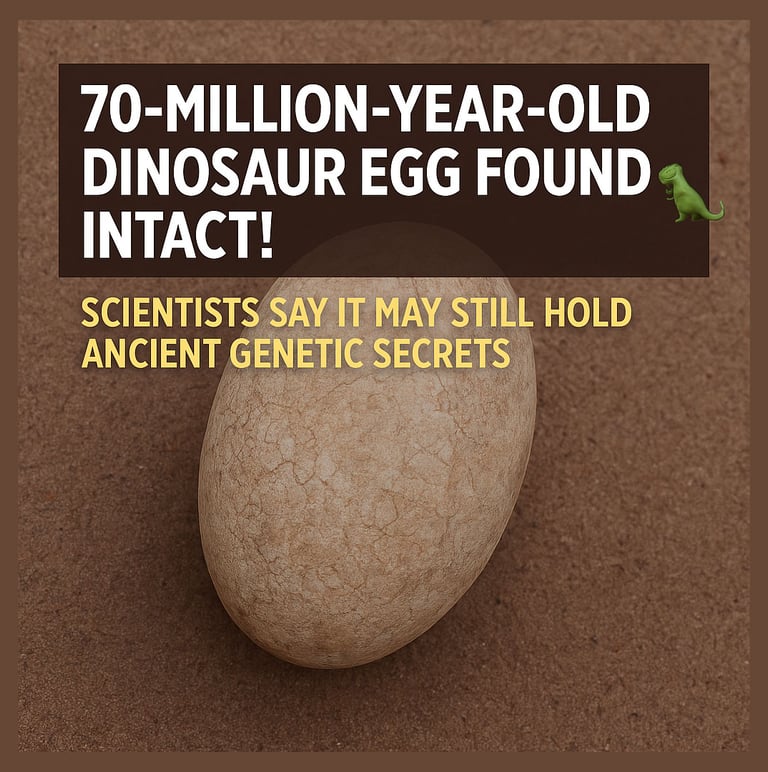
Argentine paleontologists have uncovered a perfectly preserved dinosaur egg dating back 70 million years, a discovery that could unlock new insights into prehistoric life and the evolution of modern birds.
The remarkable fossil was unearthed in Río Negro, a fossil-rich region in southern Argentina, during an ongoing excavation campaign led by researchers from the Bernardo Rivadavia Museum of Natural Sciences. The scientists described the finding as “a spectacular surprise” — not just because of the egg’s age, but because of its extraordinary condition.
“Finding dinosaur fossils isn’t rare in Argentina, but discovering a complete egg like this is incredibly unusual,”
said Gonzalo Leonel Muñoz, a vertebrate paleontologist at the museum.
A Rare Glimpse Into the Past
The egg, which is about the size of an ostrich egg, is believed to belong to the Bonapartenykus genus — a small, carnivorous theropod dinosaur that roamed South America during the Late Cretaceous period.
Unlike the more commonly found long-necked sauropod eggs, this fossil is nearly spherical, with a thicker shell and perfect outer surface, indicating it endured millions of years of geological shifts without damage.
Videos and photos shared by the Laboratory of Comparative Anatomy and Vertebrate Evolution show lead researcher Federico Agnolín gently holding the egg, which appears so well-preserved that it “looks hard-boiled,” as described in the post. The team revealed that multiple eggs — possibly forming a nest — were found during the dig.
“It’s possibly the first discovery of this species in South America,” the lab wrote on Instagram.
“The fossil is over 70 million years old — and it wasn’t alone.”
Why This Discovery Matters
Experts say carnivorous dinosaur eggs are rarely found intact because their shells were thinner and more fragile, resembling those of modern birds. These delicate structures often collapse under geological pressure, making this intact specimen exceptionally valuable for scientific study.
“The lineage of carnivorous dinosaurs eventually evolved into birds,” Muñoz explained. “So their eggs were lighter and more vulnerable — that’s why discoveries like this are so important.”
The egg will be transferred to the Argentine Museum of Natural Sciences, where detailed CT scans and laboratory tests will be conducted to determine whether it contains an embryo or preserved genetic material.
A Step Closer to Understanding Dinosaur Evolution
If the egg does contain embryonic remains, scientists say it could provide groundbreaking evidence on how dinosaur offspring developed and how their reproduction transitioned into the avian species we see today.
“If confirmed, it could show us what dinosaur chicks looked like at birth, how developed they were, and what evolutionary link exists between dinosaurs and birds,” Muñoz added.
While the researchers are keeping expectations realistic, the discovery has reignited global curiosity about ancient life — and the long-standing dream of understanding how Earth’s earliest predators once reproduced and evolved.